
Clean Label Coffee: Why Allergen-Free Matters
by Joanna Foley
·
Clean label coffee prioritizes safety, transparency, and rigorous testing to address hidden risks in conventional coffee. These risks include allergens, mold, mycotoxins, pesticides, heavy metals, and cross-contamination in shared production facilities. Brands adopting clean label practices ensure their coffee is free from harmful contaminants, providing a safer and healthier option for consumers, especially those with allergies or sensitivities.
Key Takeaways:
- Testing: Clean label coffee undergoes third-party testing for over 300 pesticides, mycotoxins, heavy metals, and microbials.
- Allergen-Free Certification: Protects against cross-contamination with common allergens like nuts, dairy, gluten, and soy.
- Health Risks in Conventional Coffee: Issues like mold, mycotoxins, and pesticide residues can cause jitters, digestive discomfort, inflammation, and long-term health problems.
- Consumer Trust: Transparency through published lab results and ingredient sourcing builds confidence in product safety.
Popular Brands:
- Lean Joe Bean: Instant blends with added wellness ingredients like mushrooms and probiotics ($36.95/month).
- Pangea Coffee: Allergen-free, low-acid coffee processed in dedicated facilities ($19.99/12 oz bag).
- Purity Coffee: Triple-tested for contaminants, focusing on high antioxidant levels ($29.00/12 oz bag).
- Mindbodygreen Clean Coffee+: Certified by the Clean Label Project, with compostable packaging and contaminant testing.
These brands stand out by addressing both allergen safety and toxin-free production, making clean coffee a smart choice for health-conscious consumers.
Lab Testing Big Brands Vs Specialty Coffee Vs "Healthy" Coffee
sbb-itb-c7947de
Problems with Conventional Coffee Production
The conventional coffee industry often struggles with managing contamination risks. Shared manufacturing facilities, where coffee is processed alongside products containing nuts, dairy, or gluten, create a significant risk of cross-contamination. This is why clean label practices are so important for ensuring allergen-free coffee. Flavored coffee production lines, for instance, can retain residues of milk proteins like casein and whey, or even traces of soy and wheat, despite cleaning efforts. For people with severe allergies, this is a serious concern, especially since advisory statements like "processed in a facility that also processes milk" are optional and not strictly regulated by the FDA.
Cross-Contamination in Shared Production Facilities
Flavored coffees and products labeled with "natural flavors" can hide milk derivatives or gluten, often without clear disclosure. Even terms like "lactose-free" can be misleading, as they don’t guarantee the absence of milk proteins that can trigger allergic reactions. This lack of transparency leaves consumers vulnerable, particularly with over 200 food proteins identified as potential allergens. These labeling gaps make it difficult for consumers to confidently assess the safety of their coffee.
Toxins and Additives in Standard Coffee
Allergen risks are just one part of the problem. Conventional coffee is often exposed to mycotoxins, pesticide residues, and heavy metals. Poor storage conditions, extended transit times, and low-grade sourcing contribute to mold growth and the formation of toxic byproducts. As James Bellis, Founder of Balance Coffee, points out:
"Poor storage and sourcing conditions foster mold growth and mycotoxin formation".
High testing costs discourage many producers from conducting thorough contaminant screenings. Additionally, only about 3% of the world's coffee is grown organically. This means the majority is treated with pesticides and chemicals, including some banned in the U.S. and Europe but still used in coffee-growing regions.
Health Effects of Coffee Contaminants
These contaminants don’t just pose theoretical risks - they have real health consequences. Many consumers report experiencing jitters, digestive issues, inflammation, and energy crashes after drinking conventional coffee. One customer shared:
"I used to get jitters and felt bad after drinking even organic brews. Then I found Balance".
Short-term exposure to contaminants can lead to headaches, anxiety, and stomach upset, while long-term exposure has been linked to kidney disease, liver damage, and weakened immune function. Often, people mistakenly blame caffeine for these effects, unaware of the hidden toxins in their coffee. To prevent mold growth, green coffee beans should be stored at a moisture level below 12.5% and a water activity level under 0.6. Unfortunately, conventional producers don’t always meet these standards, further increasing the risk of contamination.
How Clean Label Practices Build Consumer Trust
With growing awareness of contamination risks in conventional coffee, health-conscious consumers are demanding more than just assurances - they want proof. Clean label practices address this need by offering documented evidence that coffee is safe, pure, and free from hidden allergens and toxins. The key difference between brands claiming to be "clean" and those that genuinely are lies in transparency and independent verification. This verification bridges the gap between marketing promises and actual consumer safety.
Third-Party Testing for Allergens and Toxins
Independent lab testing has become the gold standard for confirming that coffee is free from harmful contaminants like mycotoxins, pesticides, and heavy metals. While testing costs can vary, a thorough lab test typically runs about $500 for a 100-gram sample - just 0.17% of a 132-pound bag - underscoring the importance of public verification.
The real game-changer? Making lab results publicly accessible. Between January and February 2026, James Bellis, founder of Balance Coffee and holder of an SCA Coffee Skills Diploma, evaluated 10 coffee brands using a standardized 100-point framework. Brands that fail to publish third-party test results scored lower in consumer trust ratings. For instance, organic certification alone earned a trust score of 14/20, while brands with published lab results achieved a perfect 20/20. Only a handful of brands go the extra mile to publish complete third-party testing results, earning higher consumer trust.
"Any brand on this list can score 20 out of 20 by publishing the same results [lab tests]. Flavour comes first because taste is why people buy coffee. Health comes second because it is why we started Balance Coffee." - James Bellis, Founder, Balance Coffee
But trust doesn’t stop at lab testing - ingredient transparency plays an equally important role.
Transparent Ingredient Sourcing and Traceability
Transparency begins at the source. Consumers want to know where their coffee comes from, how it’s processed, and what happens during transit. Farm-level traceability, including details about origin and processing methods, actively reduces contamination risks. Brands that share specifics like origin countries, altitudes (e.g., beans grown above 1,400 meters), and processing techniques such as "washed" or "wet-processed" show a proactive approach to preventing contamination right from the start.
California’s AB 899 law, effective January 1, 2025, has raised the bar for transparency. This law requires brands to disclose levels of toxic elements like arsenic, lead, cadmium, and mercury in consumer products. While the law applies broadly, it has shaped coffee consumers’ expectations for openness. As the Clean Label Project emphasizes:
"Sometimes what's not on a product label is what's most important. Because it's what's on the inside that counts."
Despite the costs of testing, leading brands like Balance Coffee and Purity Coffee make their results available for public download, avoiding vague claims. This approach has proven effective - Balance Coffee’s Stability Blend, for example, earned a 91/100 overall score and 4.9 stars from verified customers in April 2026.
Supporting Consumer Health Goals
Beyond transparency and testing, clean label coffee supports specific health goals. Many consumers turn to clean coffee to address issues like jitters, digestive discomfort, and inflammation - problems often caused by hidden contaminants, not caffeine. By ensuring verified purity, clean label brands help consumers achieve goals like weight management, sustained energy, and reduced inflammation.
Those who switch to clean coffee often report fewer digestive problems and more consistent energy levels. This is especially important for individuals using coffee as part of a broader wellness routine. For example, some brands, like Lean Joe Bean, incorporate functional ingredients such as mushrooms and probiotics to enhance health benefits. Others focus on delivering a pure, unadulterated brew.
Brands that combine high-altitude sourcing, washed processing methods, and roast-to-order freshness - with roast dates clearly printed on packaging - offer the level of transparency that health-conscious consumers crave. This shift in production practices ensures allergen-free assurance and positions coffee as a product that supports, rather than undermines, wellness goals.
Leading Clean Label Allergen-Free Coffee Brands
These coffee brands have set themselves apart by prioritizing rigorous testing to ensure allergen-free products. Their commitment goes beyond organic certifications, addressing concerns like allergen cross-contamination, mold, and heavy metal exposure, which are critical for consumer trust and health.
Lean Joe Bean Instant Blends
Lean Joe Bean offers instant coffee blends infused with wellness-focused ingredients. Their products include non-GMO, third-party tested components like green coffee beans, mushrooms, probiotics, green tea extract, and ginseng. The brand adheres to GMP standards and is Tru-ID certified, ensuring ingredient authenticity. Sold in single-serving packets, a one-month supply (24 packets) costs $36.95. Popular options like the Weight Loss Coffee and Mushroom Superfood Coffee provide metabolic support and sustained energy while maintaining allergen safety.
Pangea Coffee
Pangea Coffee is one of the few brands verified by SPOKIN, an allergen-free standard that requires dedicated facilities to prevent cross-contamination from the Top 9 allergens. Unlike conventional roasters that use shared equipment, Pangea's facilities and Q-Grader testing eliminate risks like mold and mycotoxins. This is particularly significant since 38.35% of green coffee samples globally have detectable levels of ochratoxin A. Priced at about $19.99 per 12 oz bag, Pangea also caters to consumers with GERD or acid reflux by offering low-acid coffee (pH 5.5 or higher).
Purity Coffee
Purity Coffee stands out with its triple-testing protocol, screening for mold, pesticides, and heavy metals before roasting. The brand achieved a perfect 20/20 health and purity score in independent 2026 testing and makes its lab results publicly available, setting a transparency benchmark. Sourcing organic Arabica beans from high-altitude farms in Central and South America, Purity Coffee also offers a low-histamine formulation for those with sensitivities. At $29.00 per 12 oz bag, this premium coffee reflects its extensive testing process. A 2025 Clean Label Project study revealed that AMPA (a glyphosate byproduct) and heavy metals were present in all organic coffee samples tested, highlighting the importance of such rigorous protocols.
Mindbodygreen Clean Coffee+
Mindbodygreen Clean Coffee+ combines organic quality with transparent contaminant testing. Certified by the Clean Label Project, the brand undergoes third-party testing for heavy metals, pesticide residues (including glyphosate), and plasticizers like phthalates and bisphenol. To address microplastic concerns, Mindbodygreen uses compostable, plastic-free packaging, a thoughtful choice given that plastic coffee pods can leach significant microplastics into brewed coffee. The brand also complies with California's AB 899 law, effective January 2025, which mandates disclosure of toxic elements like arsenic, lead, cadmium, and mercury.
Brand Comparison: Clean Label Coffee Options
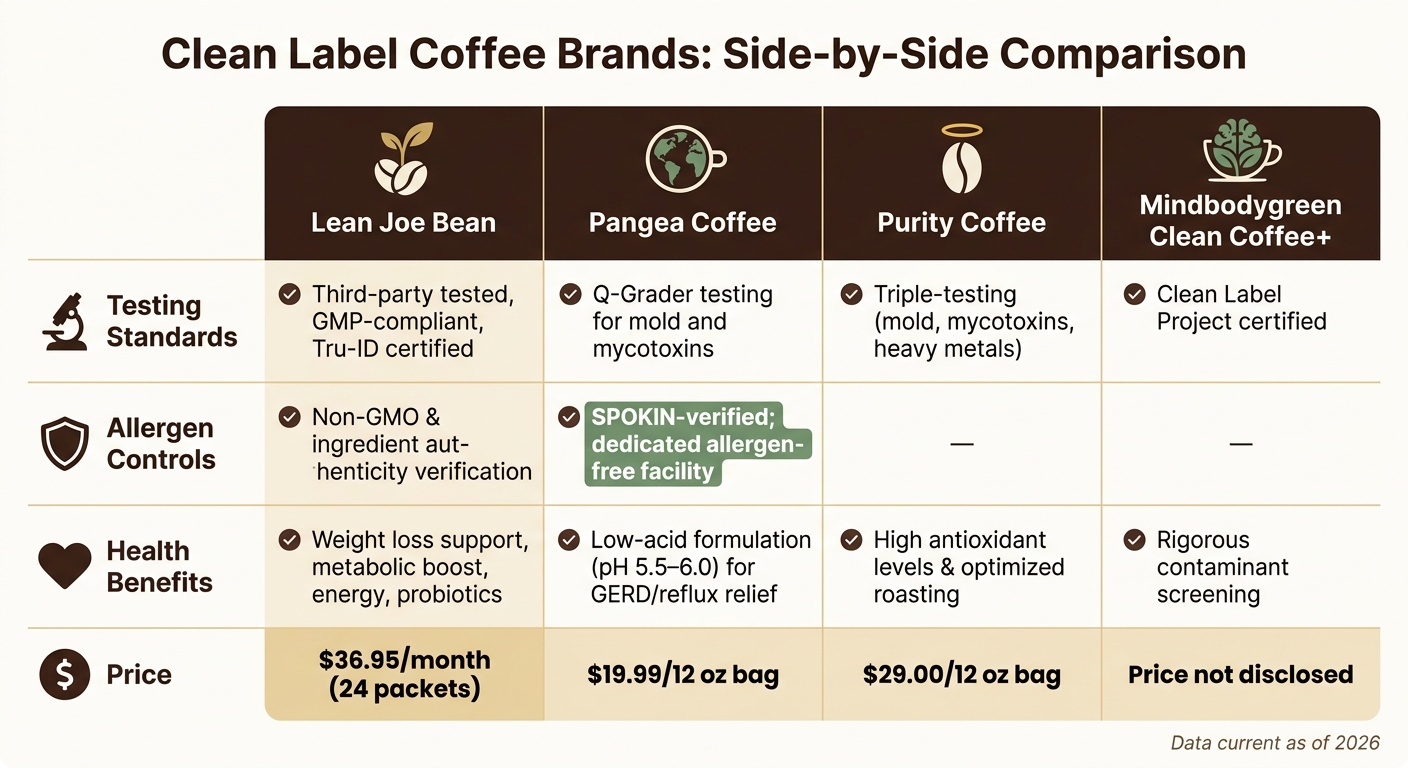
Clean Label Coffee Brands Comparison: Testing, Allergen Controls & Pricing
Side-by-Side Comparison Table
Clean label coffee brands are reshaping how we think about coffee safety, focusing on rigorous testing and transparency to build consumer confidence. When choosing the right coffee, it's worth weighing factors like allergen safety, health benefits, and cost. Prices for these brands range from $19.99 to $36.95 per month's supply, with each offering distinct advantages through unique testing and allergen control protocols.
Pangea Coffee takes the lead as the only SPOKIN-verified brand, ensuring zero cross-contamination from the Top 9 allergens in its dedicated California facility. With Q-Grader testing to meet strict allergen-free standards, it’s priced at $19.99 for a 12 oz bag, making it an affordable option for those prioritizing allergen safety.
Purity Coffee stands out with thorough third-party lab testing for mold, mycotoxins, and heavy metals. At $29.00 per 12 oz bag, it offers high antioxidant levels and carefully optimized roasting for a premium coffee experience.
Mindbodygreen Clean Coffee+ emphasizes contaminant control through Clean Label Project certification, screening for heavy metals, glyphosate, and plasticizers.
Lean Joe Bean offers instant blends for $36.95 per month (24 single-serving packets). GMP-compliant and Tru-ID certified, it combines green coffee beans, mushrooms, and probiotics, delivering metabolic support alongside allergen safety.
| Brand | Testing Standards | Allergen Controls | Health Benefits | Price |
|---|---|---|---|---|
| Lean Joe Bean | Third-party tested, GMP-compliant, Tru-ID certified | Non-GMO and ingredient authenticity verification | Weight loss support, metabolic boost, energy, probiotics | $36.95/month (24 packets) |
| Pangea Coffee | Q-Grader testing for mold and mycotoxins | SPOKIN-verified; dedicated allergen-free facility | Low-acid formulation (pH 5.5–6.0) for GERD/reflux relief | $19.99/12 oz bag |
| Purity Coffee | Triple-testing (mold, mycotoxins, and heavy metals) | – | High antioxidant levels and optimized roasting parameters | $29.00/12 oz bag |
| Mindbodygreen Clean Coffee+ | Clean Label Project certified | – | Rigorous contaminant screening | Price not disclosed |
This breakdown highlights how each brand aligns with consumer priorities like safety, health benefits, and transparency. Each option caters to different needs, helping you choose the best fit for your coffee routine.
Conclusion
Clean label and allergen-free practices play a crucial role in protecting consumers from hidden risks in the coffee industry. Beyond the obvious ingredients listed on labels, factors like mycotoxins, pesticide residues, and hormone-disrupting plasticizers can quietly undermine the health benefits coffee is supposed to provide.
"Sometimes what's not on a product label is what's most important." - Clean Label Project
The growing push for transparency puts more power in the hands of consumers, enabling them to make smarter, safer choices. California's AB 899 law, which mandates disclosure of toxic elements starting January 1, 2025, is a clear example of how consumer demand is reshaping industry standards. These changes go beyond just meeting legal requirements - they highlight the importance of robust testing protocols. Third-party testing for contaminants like mycotoxins, glyphosate, and heavy metals ensures a level of safety that traditional processing methods simply can't guarantee.
For those who prioritize their health, the advantages are clear. Clean label coffee not only minimizes risks but also addresses common issues like jitters, acid reflux, and brain fog. It helps retain the natural antioxidants and nutrients that make coffee a healthful choice in the first place. By committing to thorough testing and transparent labeling, brands aren't just following regulations - they're building consumer trust and aligning with wellness-focused lifestyles.
"Progress doesn't come from assuming 'organic' or 'natural' is enough. It comes from constant testing, innovation, and transparency." - Love Grown, Inc
Brands leading this movement - whether through allergen-free facilities or detailed lab testing - are setting a new standard for trust and accountability. As the clean caffeine trend continues to grow in 2026, consumers now have access to options that support their health goals without compromise.
FAQs
How can I tell if a coffee is truly allergen-free?
To ensure your coffee is free from allergens, choose brands that rigorously test for contaminants such as heavy metals, pesticides, molds, and chemical residues. Look for certifications or brands that openly share details about their testing procedures. This guarantees the coffee aligns with clean label standards, focusing on both safety and quality.
What tests should clean label coffee brands publish?
Clean label coffee brands need to provide third-party test results that verify their products are free from contaminants such as heavy metals, pesticides, glyphosate, phthalates, and acrylamide. It's also important to confirm there are no unlisted contaminants lurking in the coffee. Sharing these results not only ensures product safety but also strengthens consumer trust through transparency.
Can coffee contaminants cause jitters even with low caffeine?
Yes, contaminants such as heavy metals and pesticides in coffee can trigger jitters even if caffeine levels are relatively low. These harmful substances can affect the nervous system and general health, mimicking the symptoms of caffeine sensitivity. To minimize these risks and enjoy your coffee without worry, it's crucial to opt for clean-label, contaminant-free options.
Related Blog Posts
- Probiotic Coffee for Weight Loss and Gut Health
- How Dark Roast Coffee Improves Focus
- How Functional Coffee Combines Probiotics and Gut Health
- Checklist for Choosing Coffee Blends for Weight Loss
Related reading
- Low Acid Coffee: Solution for Sensitive Stomachs
- Probiotic Coffee for Weight Loss
- Say GoodBye to Heartburns: Our Favorite Low Acid Coffee Brands
Ready to put this into practice? Explore Lean Joe Bean Weight Loss Coffee and Superfood Mushroom Coffee.
